Horrifying Footage Caught on Camera, The Moment This 12,000
Horrifying Footage Caught on Camera, The Moment This 12,000-Pound Apex Predator Snapped and Ended Everything for Maris Ellington
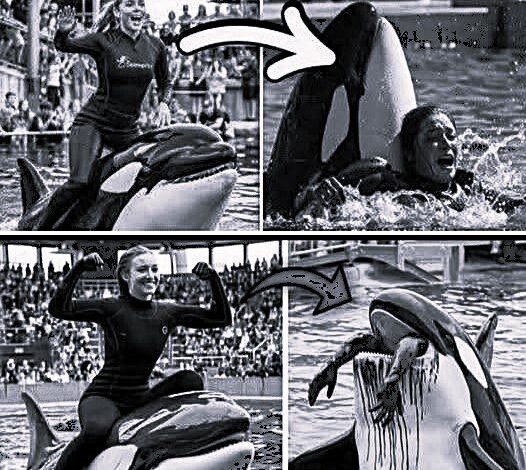
The bond between a human and a wild animal is often described as a spiritual bridge, a connection that transcends language and biology. For Maris Ellington, a senior trainer at the world-renowned Ocean World, this connection was her life’s work. She didn’t just train orcas; she lived among them, understood their vocalizations, and believed she had earned their trust. But in the high-stakes world of marine entertainment, trust is a fragile illusion. On a fateful afternoon that started like any other routine performance, that illusion shattered in front of a horrified live audience. The tragedy of Maris Ellington and the massive orca known as Cairo is a harrowing descent into the dark reality of captivity, a story that begins with a splash and ends with a scream that still echoes through the halls of marine biology.
Maris was never just an employee; she was a pioneer. Her colleagues described her as a woman who possessed an almost supernatural calm when submerged in the frigid tanks with predators that could crush a human ribcage with a single nudge. She advocated for the well-being of the animals, pushing for better diets, more stimulation, and a deeper respect for their complex social structures. To the public, she was the face of harmony between man and beast. To Cairo, a six-ton bull orca with a dorsal fin that sliced through the water like a jagged mountain peak, she was the bringer of fish and the source of play. But as any behaviorist will tell you, a captive apex predator is a ticking time bomb, and on this day, the clock finally ran out.
The performance was titled “Oceanic Majesty,” a grand display of power and grace designed to leave spectators in awe. The stadium was packed to capacity, the air thick with the smell of salt and popcorn. Maris entered the water with her signature smile, signaling to Cairo for a tandem swim. Initially, the massive whale followed the cues perfectly. They moved in a synchronized ballet, a 12,000-pound killing machine and a 130-pound woman dancing in the blue depths. But veterans of the industry noted something off in Cairo’s body language. His movements were twitchy, his vocalizations higher pitched than usual. The “bridge,” the psychological link between trainer and animal, was beginning to fray.
The turning point came during the “deep dive” segment. Maris was supposed to be propelled from the bottom of the tank by Cairo’s snout, soaring into the air in a spectacular display of physics. But when they reached the dark, pressurized bottom of the pool, Cairo did not push her up. He took hold of her. It wasn’t a bite born of hunger, but a calculated show of dominance. In an instant, the “majestic creature” became a terrifying captor. Cairo clamped his massive jaws around Maris’s waist and began a series of rapid descents and ascents, a behavior known as “rag-dolling.” To the audience above, the water was a churning foam of white and red. To Maris, it was a fight for her very soul.
The emergency protocols at Ocean World were activated within seconds, but against a six-ton orca, human intervention is laughably inadequate. Divers jumped into the tank with nets and acoustic deterrents, but Cairo was in a state of predatory psychosis. He retreated to the deepest part of the enclosure, holding Maris beneath the surface for minutes at a time. The psychological break was complete; the years of training, the buckets of fish, and the “extraordinary bond” meant nothing in the face of a captive animal’s pent-up frustration and redirected aggression. By the time the staff managed to coax Cairo into a medical pen and recover Maris, the light had gone out of the world’s most famous trainer.
The aftermath of the Maris Ellington tragedy was a seismic event that shook the foundation of the marine park industry. The “darker side of captivity” was no longer a theory discussed in hushed tones by activists; it was a televised reality. Investigative journalists began digging into Cairo’s past, discovering a history of lunging incidents and aggressive outbursts that had been scrubbed from the public record to protect ticket sales. It became clear that Cairo wasn’t a “killer whale” by nature, but a “made” killer—a creature driven to madness by the sensory deprivation of a concrete tank that was essentially a bathtub for an animal meant to roam a hundred miles of ocean every day.
Maris Ellington’s story is not just a tragedy of a life lost; it is a catalyst for a global reckoning. Her death ignited a firestorm of ethical debate regarding the morality of using highly intelligent, sentient beings for human amusement. How can we call it education when the environment is an artificial prison? How can we speak of trust when the animal is deprived of its family and its freedom? These questions, once sidelined, became the focal point of a movement that has led to landmark legislation across the globe, banning the breeding of captive orcas and phasing out theatrical performances.
But the legacy of Maris Ellington is complex. She loved these animals with a ferocity that few could understand. She died at the hands of the creature she loved most, a paradox that serves as a grim reminder of the unforeseen consequences that arise when we try to domesticate the wild. Her story is a map of scars—both the physical scars on the animals she cared for and the emotional scars left on the community that witnessed her downfall. It is a narrative of broken trust, not just between a trainer and a whale, but between humanity and the natural world. We convinced ourselves that we could control the ocean, that we could put a leash on the abyss, and Maris paid the ultimate price for that arrogance.
Today, the tank where the incident occurred sits empty, a silent monument to a lesson learned too late. Cairo has been moved to a sea-pen sanctuary, away from the flashing cameras and the booming music, where he can finally hear the true rhythms of the tide. Maris’s name is now synonymous with reform. She is the reason your children may never see a captive orca jump through a hoop for a piece of frozen herring. She transformed a private horror into a public testimony, proving that radical transparency is the only way to heal the rift we have created with the wild.
The mask of the “happy whale” is gone, and what it revealed was terrifying, beautiful, and painfully real. We must look at the tragedy of Maris Ellington and see it for what it truly is: a desperate cry for mercy from a majestic species that never asked to be our entertainment. Her life was a tribute to the ocean, and her death was a demand for its protection. As we move forward, her story remains a haunting archive of survival and a reminder that true respect for nature doesn’t involve a cage; it involves the humility to let go. The era of the “Ocean World” spectacle is dying, and in its place, a new sanctuary of truth is being built—one where the only thing we capture is the wisdom to leave the giants of the deep in peace.






Comments
Post a Comment